Coaching has long been a cornerstone of leadership in life sciences organizations, especially across sales teams. But as roles grow more complex, expectations increase, and performance cycles accelerate, many organizations are discovering a critical gap: coaching needs to move beyond isolated events and become a core component of a broader developmental continuum.
To drive sustained behavior change and measurable outcomes, leading organizations are shifting from episodic coaching to continuous development.
So what’s the difference—and why does it matter now?
Traditional Coaching: A Moment in Time
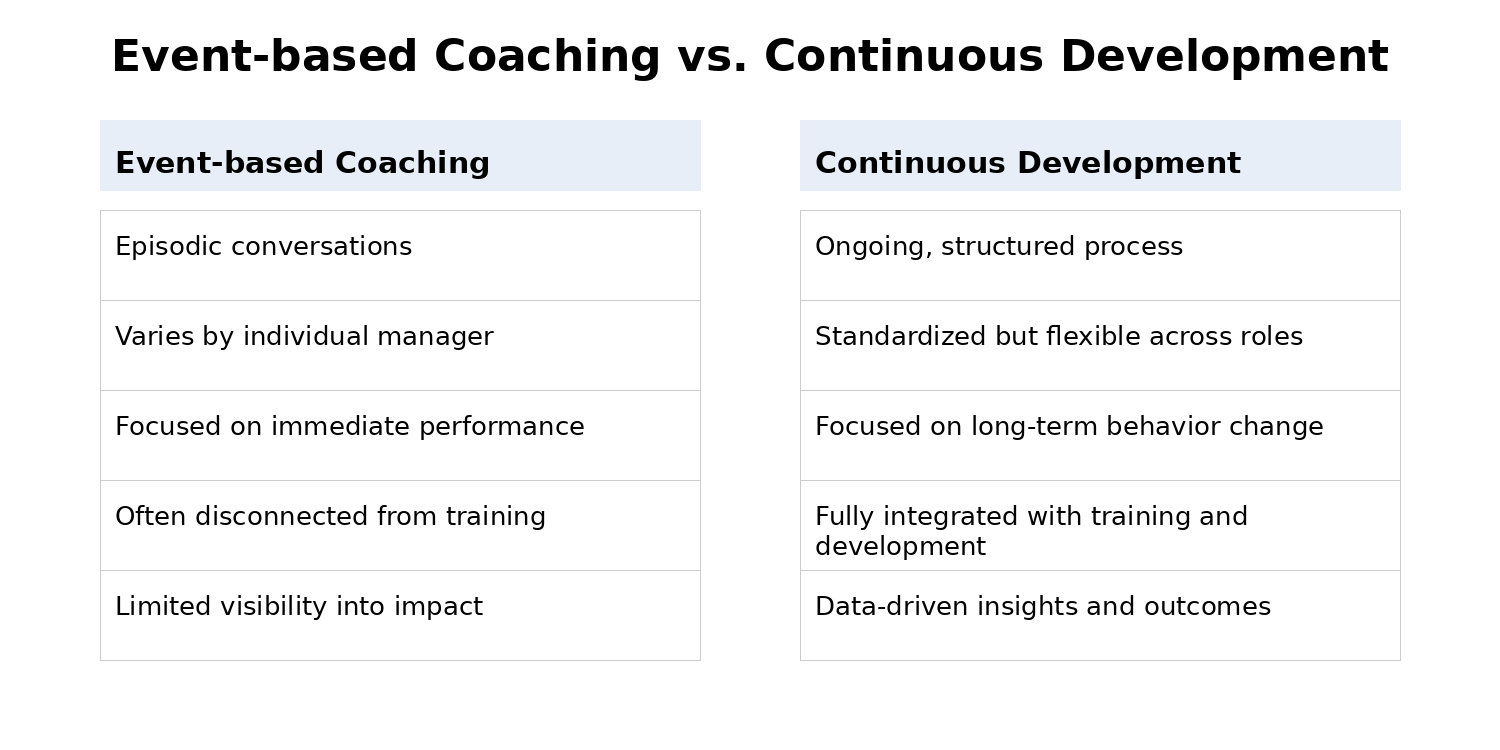
Traditional coaching focuses on individual interactions between a manager and team member. These moments may happen during field ride‑alongs, performance reviews, or issue‑driven conversations.
Done well, coaching can:
- Drive greater engagement and motivation
- Reinforce skills and behaviors
- Address performance gaps
- Provide real‑time feedback
- Build stronger manager‑employee relationships
In many organizations, however, coaching is:
- Inconsistent across managers
- Difficult to standardize
- Poorly connected to training
- Measured by activity rather than impact
Coaching often becomes something that happens when there’s time, or when required for documentation—rather than a structured driver of long‑term development.
Continuous Development: A System, Not an Event
Continuous development expands coaching into an ongoing, structured system designed to drive consistent growth over time.
Rather than relying on isolated conversations, continuous development:
- Integrates coaching and training
- Uses data to identify development needs
- Applies proven methodologies across roles
- Reinforces behaviors through repetition and continuous feedback
- Evolves as roles, strategies, and markets change
In a continuous development model, coaching becomes one component of a broader ecosystem, supported by tools, analytics, and structured workflows that enable scale without sacrificing quality.
This approach is especially critical in life sciences, where:
- Field roles are highly regulated and complex
- Scientific and product knowledge evolves rapidly
- Managers are often promoted for performance, not coaching expertise
- Leadership needs visibility across large, distributed teams
Why Life Sciences Teams Are Rethinking the Model
Market pressures, increased scrutiny, and evolving expectations are forcing life sciences organizations to ask harder questions:
- Are managers equipped to coach consistently and effectively?
- Can we see what behaviors are being reinforced—and where?
- Are we using data to guide development, or just documenting activity?
- Are coaching and training aligned to real performance needs?
Without moving toward continuous development, many organizations struggle to answer these questions with confidence.
Turning Coaching Into a Strategic Advantage
This is where next‑generation coaching and development platforms like iCoach come into play.
Purpose‑built for life sciences organizations, iCoach enables:
- Structured coaching workflows across sales, medical, access, and patient services teams
- Integration of coaching and training for needs‑based development
- Advanced analytics to understand coaching quality, focus areas, and trends
- AI‑powered tools that support managers—not replace them
- Visibility into how coaching drives behaviors and business outcomes
Rather than treating coaching as documentation, iCoach helps organizations embed coaching within a continuous development strategy—turning everyday interactions into measurable impact.
The Takeaway
Coaching and continuous development are not competing ideas. Coaching is an action. Continuous development is a strategy.
Organizations that move beyond episodic coaching—and invest in systems that support ongoing development—are better positioned to:
- Increase individual and team performance
- Improve manager effectiveness
- Drive consistent field behaviors
- Align training with real‑world needs
- Turn coaching into a lasting competitive advantage
In today’s life sciences environment, the question isn’t whether coaching matters.
It’s whether your organization is enabling it to truly work.