
In today’s highly regulated, data-driven, and competitive life sciences environment, pharmaceutical, biotech, and medical device companies face increasing pressure to operate faster, more efficiently, and more intelligently. From commercial operations and regulatory compliance to supply chain management and financial planning, the number of business-critical processes that must work in harmony has never been greater.
Traditionally, many organizations have tried to address these needs by purchasing point solutions—individual software tools designed to solve specific problems. On the surface, these systems can look attractive for their specialized functionality. In practice, however, they often introduce fragmentation, inefficiencies and escalating costs that are hard to control.
As a result, SaaS-based companies that offer comprehensive, fully integrated platforms are becoming the preferred choice for business leaders, IT organizations, strategic sourcing teams, and CFOs alike.
This shift is not a passing trend; it represents a strategic evolution driven by measurable business outcomes.
This article explores why integrated SaaS platforms are preferred, along with their benefits and trade-offs while also providing insights for decision-makers across business, IT, procurement, and finance on how to evaluate the best approach for their organizations.
The Growing Complexity of Life Sciences Operations
Life sciences manufacturers operate in one of the most complex business environments in the world. They must simultaneously manage:
- Strict regulatory and commercial compliance requirements
- Large volumes of structured and unstructured data
- Global commercial and supply chain operations
- Multiple stakeholders across R&D, manufacturing, sales, and finance
- Increasing scrutiny on cost control and ROI
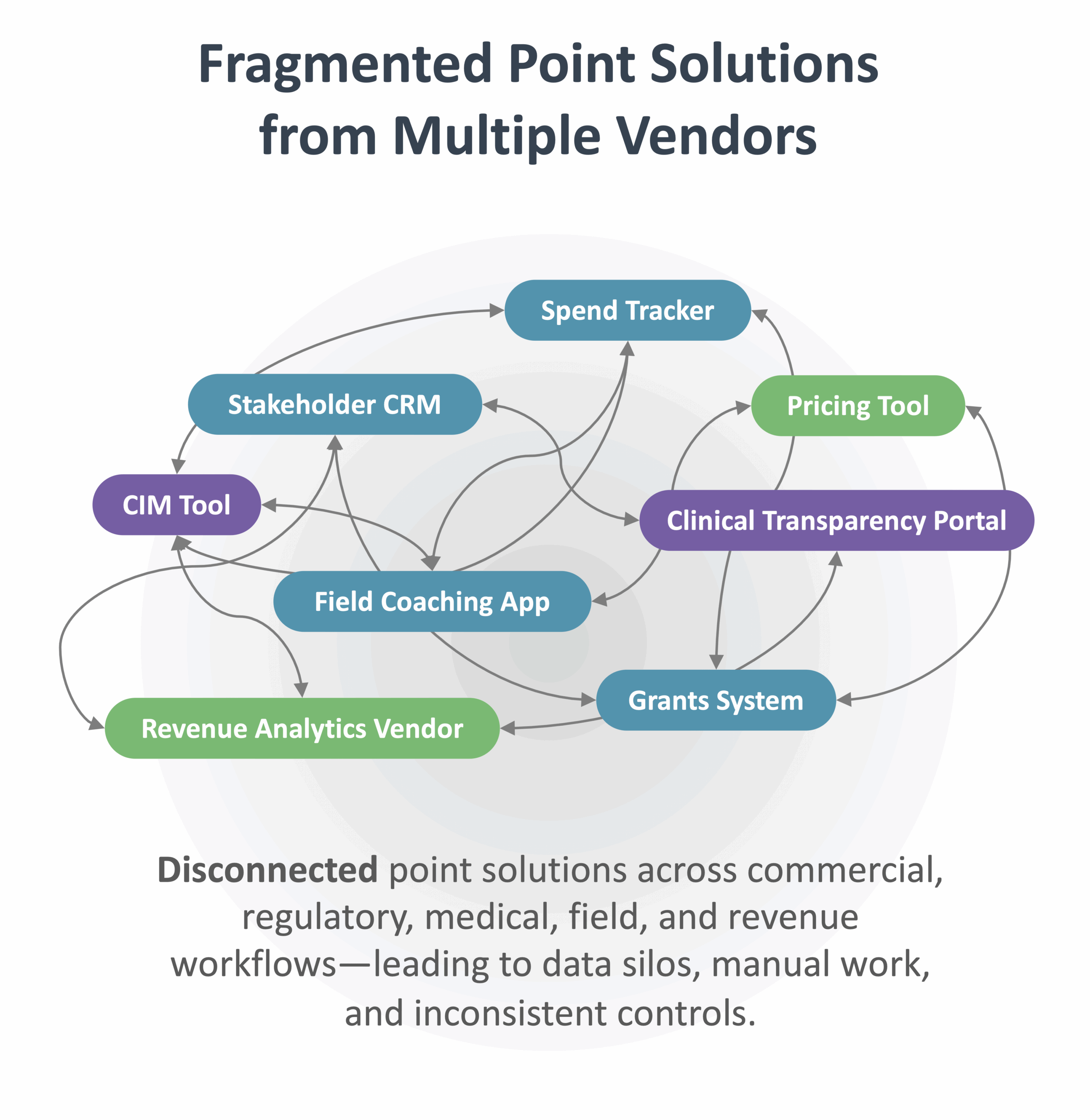
Each of these functions generates data that must be accurate, auditable, and accessible in real time. However, when organizations rely on multiple disconnected point solutions, they often encounter:
- Data silos and inconsistent reporting
- Manual data reconciliation and duplicated effort
- Delays in decision-making
- Higher operational and IT overhead
- Increased compliance and security risks
Over time, the cumulative impact of these inefficiencies becomes a strategic disadvantage and a significant cost burden.
Integrated SaaS Platforms: A Holistic Approach to Business Challenges
 Integrated SaaS platforms are designed to address multiple business challenges within a single, unified architecture. Rather than stitching together disparate tools, these platforms provide end-to-end capabilities across functional areas, with shared data models, workflows, and analytics.
For life sciences companies, this means:
- A single source of truth for enterprise data, such as for global FMV rates and Tiering
- Seamless workflows across departments for Stakeholder Engagement, Events Management, and Third-Party Due Diligence
- Consistent governance, security, and compliance controls aligned with global requirements and internal policies and procedures
- Faster implementation of new capabilities that support digital and IT strategies
- Scalable infrastructure that can grow with the business while mitigating risk
This approach aligns closely with how life sciences companies actually operate: decisions in one function (such as pricing, contracting, or engagement) directly affect risk, revenue and performance in others.
Why Business Leaders Prefer Integrated Solutions
1. Better Decision-Making Through Unified Data
Chief Commercial Officers, Chief Compliance Officers, Medical Affairs, CFOs, and business leaders rely on timely, accurate insights to drive strategy and execute to enable compliant growth. Integrated platforms eliminate the need to reconcile data across multiple systems, providing real-time visibility into performance metrics across the organization.
With an integrated platform, they no longer need to reconcile data from multiple systems to answer basic questions about spend, engagement activity, or regulatory exposure. Instead of asking, “Which system has that report?” they can focus on, “What action should we take?”
2. Faster Time to Value
Point solutions often require lengthy integration, custom development, and ongoing maintenance before they deliver business value. Integrated SaaS platforms are designed to work together out of the box, shortening implementation timelines and allowing organizations to respond more quickly to regulatory changes or market shifts.
3. Improved Cross-Functional Collaboration
Life sciences success depends on collaboration between commercial, compliance, regulatory, medical affairs, and finance teams. Integrated platforms enable shared workflows and common KPIs, reducing friction and improving alignment across the organization.
Why IT Organizations Favor Integrated SaaS Platforms
1. Reduced Integration Complexity
Chief Information Officers and IT teams are under pressure to simplify their technology landscape.. Each point solution introduces new APIs, data mappings, security considerations, and upgrade cycles.
Consolidating onto an integrated platform helps IT:
- Reduce the number of vendors to manage
- Standardize data and security models
- Streamline upgrades, validation and maintenance
2. Enhanced Security and Compliance
Life sciences companies must meet strict regulatory standards, including data privacy, validation, and audit requirements. Managing compliance across multiple vendors increases risk.
Integrated platforms enable centralized security controls, consistent validation frameworks, and unified audit trails, which make inspections and audits more straightforward.
3. Scalability and Futureproofing
As organizations grow or expand into new markets, IT needs to scale systems quickly. Integrated SaaS platforms are designed for scalability, allowing companies to add users, modules, or geographies without re-architecting their entire technology stack.
Strategic Sourcing and Procurement: Fewer Vendors, Greater Value
From a strategic sourcing perspective, managing dozens of point solution vendors creates unnecessary complexity. Each vendor requires separate contracts, negotiations, renewals, and performance management.
Integrated SaaS platforms offer procurement teams:
- Vendor consolidation and stronger strategic relationships
- More predictable pricing and clearer service levels
- Reduced administrative overhead on renewals, legal review, and vendor management
While the initial investment may appear higher than a single point solution, the total cost of ownership (TCO) is often significantly lower when integration, maintenance, and operational costs are considered.
CFO Perspective: Financial Transparency and ROI
Chief Financial Officers are increasingly involved in technology decisions, and for good reason. Fragmented systems obscure true costs and limit financial visibility.
Integrated SaaS platforms improve:
- Cost attribution across functions and business units
- Forecasting and budgeting for technology operations
- Measurement of ROI on software and services investments
By aligning technology investments with business outcomes, CFOs gain greater confidence that software spend is driving measurable value.
Pros and Cons: Integrated SaaS vs. Point Solutions
Pros of Integrated SaaS Platforms
- Unified data and analytics across functions
- Reduced integration and maintenance costs
- Faster decision-making and response to change
- Stronger compliance, security, and audit readiness
- Stronger cross-functional alignment and governance
- Vendor consolidation and clearer accountability
- Better business outcomes
Cons of Point Solutions
- Data silos and inconsistent or conflicting reporting
- Higher integration and maintenance costs over time
- More complex vendor and contract management
- Greater security and compliance risk
- Slower, less confident enterprise-wide decision-making
Making the Right Choice for Your Organization
For life sciences companies, the decision is no longer just about software feature checklists. It is about operating model, scalability, reducing risk, long-term value, and better business outcomes. While point solutions may still have a role in niche scenarios, the overwhelming preference among leading organizations is shifting toward comprehensive, integrated SaaS platforms.
By choosing vendors that understand the unique challenges of pharmaceutical, biotech, and medical device industries—and that offer fully integrated, enterprise-grade solutions—companies can simplify their technology landscape, reduce risk, and unlock greater business performance.
If your organization is evaluating whether to consolidate systems or invest in a more integrated platform, now is the ideal time to assess your current landscape, identify gaps and redundancies, and build a phased roadmap toward a more unified, future-ready architecture. To explore how an integrated SaaS platform can support your specific compliance and growth objectives, contact our team to schedule a brief discovery discussion.
January 20, 2026
Seth Houston
Chief Commercial Officer